Car lights – when to use high beams and when fog lights?
Dipped, high, parking, daytime running... Confused about light types? We explain when and how to use specific lights on the exam and daily.

Editorial Team
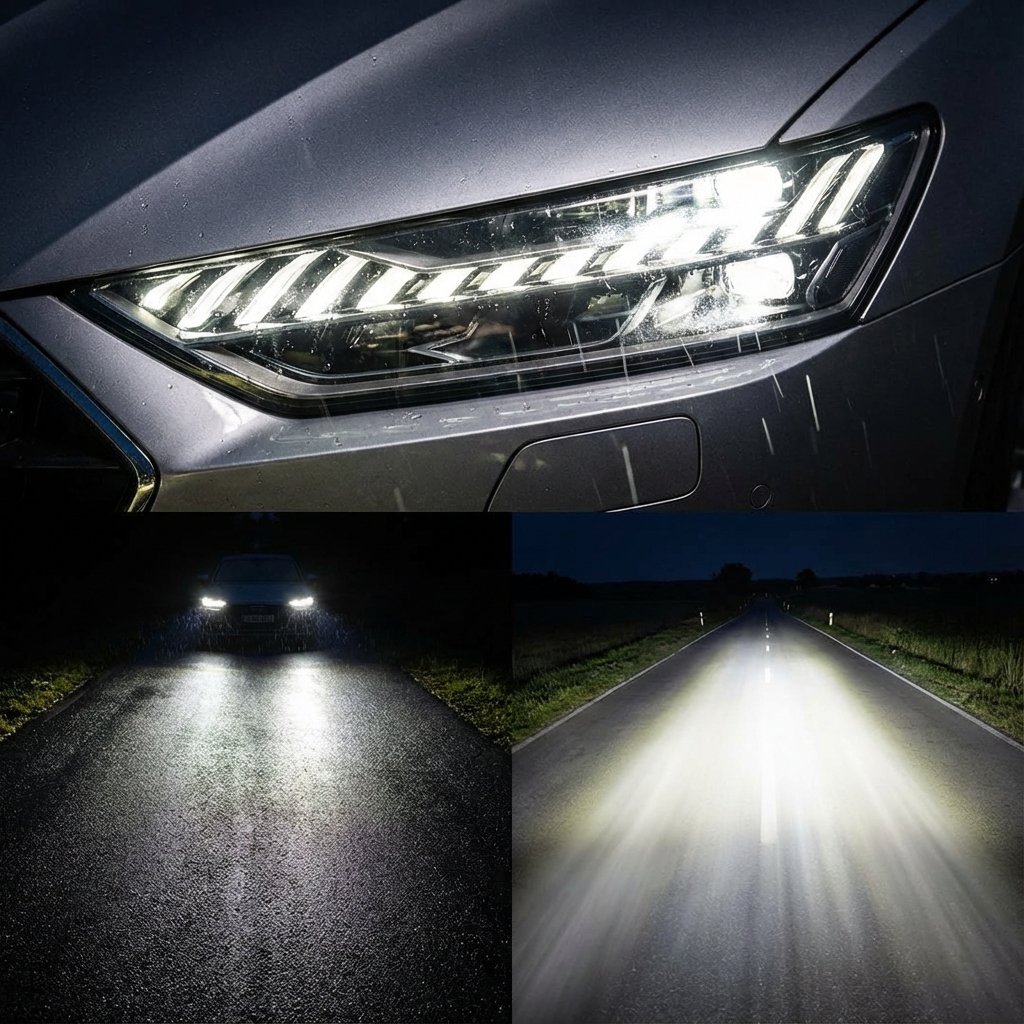
Driving License Experts Team
"Please convert on rear fog lights". If you start panic searching for the switch on the exam, you lose points and nerves. Lighting is the basis of safety and... frequent questions on the theoretical exam. Let's organize the knowledge.
1. Daytime Running Lights (DRL) vs Dipped Beam
Most new cars ("L-plates" are usually new) have daytime running lights (LED at the front). They turn on automatically after starting the engine.
- When to use? Only during the day, with good air transparency.
- When NOT to use? In a tunnel, during rain, in fog, at dusk. Then you MUST switch to dipped beam.
Exam question: "Can you drive on daytime running lights during rain?". NO. You must turn on dipped beam.
2. Dipped Beam (Short)
These are your basic lights.
- Obligation: In Poland we drive with lights on around the clock (unless we have daytime and it is bright).
- Application: Rain, fog, night, tunnel.
3. High Beam (Long)
Used to illuminate the road at a long distance. They blind others, so they are restricted by prohibitions.
- When to use? From dusk to dawn, on unlit roads.
- When to turn off?
- When a vehicle approaches from the opposite direction (not to blind them).
- When approaching a preceding vehicle (not to blind them in mirrors).
- When you see a pedestrian in a column or a cyclist.
- In a built-up area, if the road is lit by streetlamps (then high beams are unnecessary and forbidden).
You can use them to give light signals (short blink) in case of danger, but not to "rush" others!
4. Fog Lights (Halogens)
Here drivers make the most mistakes, blinding others in light rain.
Front (optional equipment, but L-cars have them)
- When to use? In conditions of reduced air transparency (fog, heavy rain, snowstorm).
- Curiosity: You can also use them on a winding road marked with a special sign, even on a clear night (they illuminate corners).
Rear (MANDATORY and very important)
It is a very strong, red light that blinds the driver behind you like a laser.
- When to use? ONLY when visibility drops below 50 meters. It's really thick fog ("milk").
- When to turn off? Immediately when visibility improves. If you drive in fog, but another car is behind you, it is also worth turning off, because they see you anyway, and you burn their eyes.
5. Position and Parking Lights
Often confused.
- Position: Mark the position of the vehicle. Must be visible from 300m. You use them e.g. during towing.
- Parking: When you stop at night in an unlit place.
Checking lights on the exam
The first task on the square is checking technical condition. The examiner will ask you to check a drawn light.
- Fog: Remember they only turn on with dipped beam on (and sometimes ignition must be on)!
- Brake: You must ask the examiner for help ("Please check if they work, I will press the brake").
- Reverse: Turn on ignition (without engine), put in reverse, go out and check at the back.
Knowledge of lights is not just a point on the exam, it is your visibility and safety. Do not underestimate this!
Related articles
Driving in rain and fog – technique and regulations we forget about
Autumn and winter are tough times for drivers. How to avoid aquaplaning? How to use wipers and lights? Guide to safe driving in difficult conditions.
Dashboard warning lights – what do they mean and can you drive with them?
Red, yellow, green... Dashboard lights are your car's language. Learn which ones mean failure and which are just information.