Turning back in three, at an intersection and using architecture – how to do it?
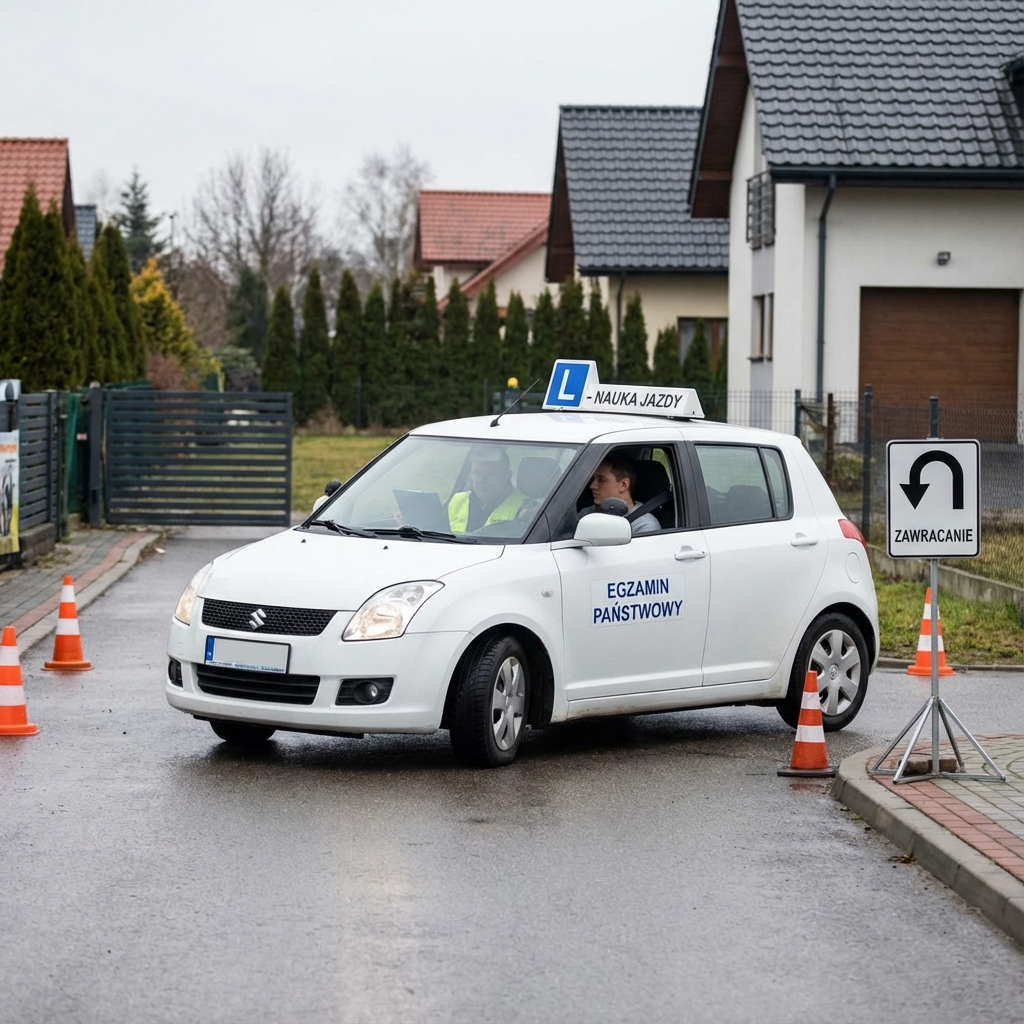
Turning back is a sure thing on the exam. Learn 3 main ways to turn back: at an intersection, using infrastructure (gate), and the famous 'three-point turn' (using reverse gear).

Instructor Tomek
Instructor with 15 years of experience
"Please turn back at the nearest intersection" or "Please turn back using infrastructure". You will definitely hear these commands. How not to panic and choose the best method? Here is your guide to turning back techniques on the exam.
1. U-turn at an intersection (most common)
This is the maneuver we perform most often in city traffic.
With traffic lights (collision-free)
If you have a left turn arrow (S-3) (one where the arrow is left and down, "U-turn"), it's simple: you have the right of way, no one will cut you off. If you have a regular left arrow (only left), U-TURNING IS FORBIDDEN! (Unless road markings say otherwise, but usually S-3 directional left forbids U-turns). At a general signal (S-1), you turn back, yielding to those coming from the opposite direction going straight and right.
Without lights
The rule is simple: yield to everyone from the opposite direction.
- Tip: Drive to the middle of the intersection, but don't turn the wheels too early, so if rear-ended, you don't fall into the opposite lane.
2. U-turn using infrastructure (gates, driveway)
The examiner will say: "Please turn back using reverse gear, utilizing the driveway on the right side".
How to do it?
- Pass the driveway/gate (point you want to enter backwards).
- Stop behind it, at the right edge (right indicator!).
- Put in reverse, right indicator (because the rear turns right).
- Reverse, entering the driveway backwards.
- Stop, put in first gear, left indicator and drive out forward to the left (return where you came from).
Harder variant (driveway on the left):
- Enter forward into the ticket/gate on the left side (left indicator).
- Reverse onto your lane (drive out backwards to the right).
- Stop, first gear, and drive forward.
3. "Three-point turn" (on a narrow road)
Officially: "Turning back on a single-carriageway two-way road". You do this where there is no other option (e.g., dead-end street approx. 6-8 meters wide).
Instructions:
- To the edge: Pull over maximally to the right edge of the roadway. Stop.
- Left indicator + Full turn: Turn on left indicator. Turn steering wheel all the way to the left (while stopped or rolling minimally).
- Drive forward: Move and drive almost to the curb on the other side of the street. Stop just before it (don't hit!).
- Reverse + Full right: Quickly turn steering wheel all the way to the right. Put in reverse. Right indicator (some examiners require, others don't – better to turn on).
- Reversing: Reverse as much as needed to make the exit.
- Exit: First gear, steering wheel left, and go.
Most common mistake: Turning the steering wheel too slowly in relation to speed. On a three-point turn, the arm must work fast!
Where is U-turning FORBIDDEN? (Traps)
The examiner might give a command "please turn back in the nearest possible place". Don't get caught! U-turning is prohibited:
- In tunnels.
- On bridges and viaducts.
- On highways and expressways.
- Where there is a solid line.
- Where left turn is prohibited (because left turn prohibition also covers U-turning!).
Safe journey and successful maneuvers!